Author: Xiao Yanyan, Jinshi Data
Federal Reserve Chairman Kevin Warsh declined to endorse or refute recent signals from his colleagues that Fed officials are in no hurry to raise interest rates this month. He stated thatthe Fed no longer signals policy decisions in advance and that he would not provide any clues about the remaining two Fed meetings this year.
Warsh said the global economy has been “broadly in line” with central bank expectations since the September rate hike, but he declined to reveal what action would be taken at the upcoming meeting.
Warsh said, "I'm not going to predict the outcome of the meeting in advance. I don't think we should announce now what actions we might take at the upcoming meeting.This is a new chapter for the Fed; we're not doing that anymore."
“We have made it very clear that we will achieve price stability,” Walsh said.
Warsh made the remarks during a moderator-led discussion on Friday morning local time in Bangkok, while attending an International Monetary Fund (IMF) meeting. This comes as Federal Reserve officials enter their blackout period ahead of their October 27-28 policy meeting.
IMF Managing Director Kristalina Georgieva later joked that Walsh's remark disappointed many viewers.
Last month, the Federal Reserve unanimously raised interest rates by 25 basis points, increasing the target range for the federal funds rate to 3.75%-4%. This was the Fed's first rate hike in three years. In the interest rate projections released at the time, most of Warsh's colleagues expected at least one more rate hike this year.
Warsh previously stated that he wanted investors to focus on the economy itself, rather than on hints from Federal Reserve officials regarding the next policy move. However, two weeks ago, several senior Fed officials who had been working with Warsh on policy strategy signaled that the central bank was in no hurry to raise interest rates again this month. Since then, bets on an October rate hike in the futures market have rapidly declined.
However, September inflation data released this week was stronger than expected. Excluding volatile food and energy prices, the core consumer price index (CPI) rose 0.33% month-over-month in September, marking the second consecutive month of strong growth. Another producer price indicator released on Thursday also showed strong performance.
The Federal Reserve's October policy meeting will be held less than a week before the US midterm elections. This means that whether the Fed chooses to raise interest rates or keep them unchanged, it may face more political scrutiny than usual.
The dollar continued to weaken during Warsh's speech because traders did not hear any hawkish comments from him.
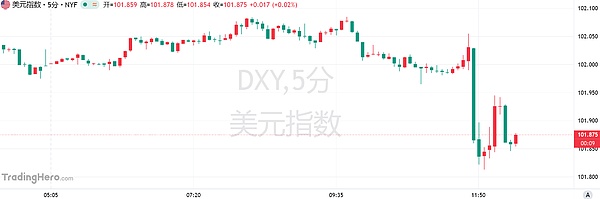
On other topics, Warsh stated that the surge in US investment is partly due to sound macroeconomic policies. In praising the US economy, he said the US is experiencing a "massive investment boom," and any notion of "long-term stagnation" is a thing of the past.
Walsh said that, given what was happening in the geopolitical sphere, he wouldn't have imagined five months ago that so many G20 countries would be performing so well. He added, "Of course, the United States has always been strong."
He stated, "We are facing common challenges and taking action, which I think is a positive development." He added, "I am optimistic that, while some may consider this overly naive, at least for the United States,we will emerge from this shock stronger, with a more solid economic foundation, and better positioned to lead global economic growth."
Warsh revealed that the Federal Reserve's Productivity and Employment Task Force will hold an in-person hearing in the San Francisco Bay Area on November 16, focusing on issues such as the impact of AI on the economy. He stated that the task force will conduct in-depth research into the impact of artificial intelligence on economic activity and the job market.
In June of this year, Warsh established five special working groups comprised of external experts to study key areas in monetary policy formulation. He previously stated that these working groups are expected to submit policy recommendations to the Federal Reserve around the end of this year.
Walsh said he is optimistic that artificial intelligence will enable economies that fully utilize it to increase productivity and wealth, but he warned thatthe road will be “very bumpy” and its short-term impact on employment is still unclear.
Source:Global Cybersecurity Alliance (GCSA)
Website:www.gcsa.org
Langgan berita, terus ke e-mel
Kami menghormati privasi anda. Lihat Dasar privasi