The period for Russian citizens to directly buy and sell cryptocurrencies ends on July 1, 2027. After that, all transactions must be conducted through brokers or exchanges approved by the Central Bank of Russia.
Abstract:The Central Bank of Russia confirmed in a Frequently Asked Questions (FAQ) released on October 12 that, under the new law, direct cryptocurrency transactions between individuals will only be legal until July 1, 2027.
The regulator also stated that individuals are prohibited from transferring cryptocurrency from digital accounts to their own non-custodial wallets, or from transferring it between individuals through addresses operated by digital custodians.
Sberbank, Russia's largest cryptocurrency exchange, joined the central bank's register of cryptocurrency exchanges on October 12 and plans to launch its first cryptocurrency products on December 1.
Russians have over eight months left to trade Bitcoin and other cryptocurrencies directly with each other. The Central Bank of Russia confirmed this week that peer-to-peer deals (where two people exchange rubles for cryptocurrency directly without a regulated intermediary) will no longer be legal from July 1, 2027.
This clarification is included in the latest guidance published by the regulator on its official website on October 12.
The legal basis for this is the Federal Law No. 282-FZ, "On Digital Currencies and Digital Rights," which was signed by President Vladimir Putin on August 4 and came into effect on September 1. Article 30 of the law lists cryptocurrency transactions that residents can conduct without a licensed intermediary, but from July 2027, this list will no longer include transactions between individuals.
From that date onward, residents can only conduct cryptocurrency transactions through companies that "organize the circulation of digital assets," or directly with such companies—primarily brokers licensed by the Central Bank of Russia and cryptocurrency trading organizations listed on their register.
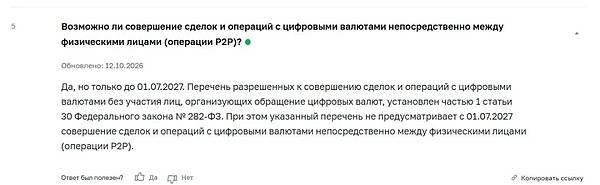
Regulators also noted that individuals are prohibited from transferring cryptocurrency from digital accounts to their own non-custodial wallets (i.e., wallets where the private keys are held by the owner, not a company). Transfers between individuals through addresses operated by digital depositories (licensed companies that record cryptocurrency ownership) are also prohibited, even if it is for the purpose of settling transactions between the parties.
Ordinary users are also prohibited from lending cryptocurrency: only brokers, trustees, trading organizations, and clearinghouses can act as lenders of cryptocurrency loans.
Since Binance sold its Russian operations to CommEX in 2023, the standard way for Russians to acquire stablecoins has been through peer-to-peer transactions: the buyer transfers rubles to the seller's bank account in exchange for receiving USDT, a token pegged to the US dollar. The new regulations are ending this model.
In an interview with Kommersant FM, Andrei Tugarin, managing partner of GMT Legal, stated that starting July 1, 2027, Russian banks will be required to refuse clients attempting to fund cryptocurrency wallets on overseas platforms and will be unable to accept rubles withdrawn from these platforms.
Non-accredited investors (i.e., individuals without professional investor status) must pass a test and are capped at 300,000 rubles (approximately $3,600) per year in cryptocurrency purchases, while accredited investors have no such limit. The central bank's list of non-accredited buyers includes only Bitcoin, Ethereum, and USDT.
According to Interfax, Sberbank, Russia's largest lender, joined the central bank's register of cryptocurrency trading organizations on October 12 and plans to launch its first cryptocurrency products on December 1. VTB Bank and T-Invest Lab are also on the register.
Cryptocurrency trading organizations must be Russian companies with at least 15 million rubles (approximately US$179,000) in share capital and be registered with the central bank, although they can continue to operate without registration until July 1, 2027.
The law still prohibits Russians from spending cryptocurrency domestically and maintains the ban on using digital assets to pay for goods and services, but allows the use of cryptocurrency in foreign trade settlements. Kaplan Panesh, deputy chairman of the State Duma Budget Committee, publicly stated when the bill passed its first reading in April that this exception was a means of circumventing sanctions.
Source:Global Cybersecurity Alliance (GCSA)
Website:www.gcsa.org
ニュースをメールで受け取る
お客様のプライバシーを尊重します。詳細は プライバシーポリシー