The money was taken by the scammers and exchanged for Bitcoin. More than a decade later, Bitcoin has increased in value by 200 times, and the scammers have been caught.
Anyone would be thinking: Surely I can get my money back this time? And it's worth much more than it was back then, so can I get the extra money too?
The most concerning issue in the Qian Zhimin case is this very question that has made the news this time.
On October 12, 2026, the UK High Court ruled that the property rights claimed by Chinese investors regarding the Bitcoin in question should be determined under Chinese law. Caixin reported on this, suggesting the victims may miss out on the enormous appreciation. Qian Zhimin bought Bitcoin on the Huobi exchange in 2014 at an average price of approximately 2,815 yuan per coin; now it's worth about 540,000 yuan, roughly 200 times the purchase price.
This figure is very tempting, but unfortunately it is not even a multiple of the compensation for the victims.
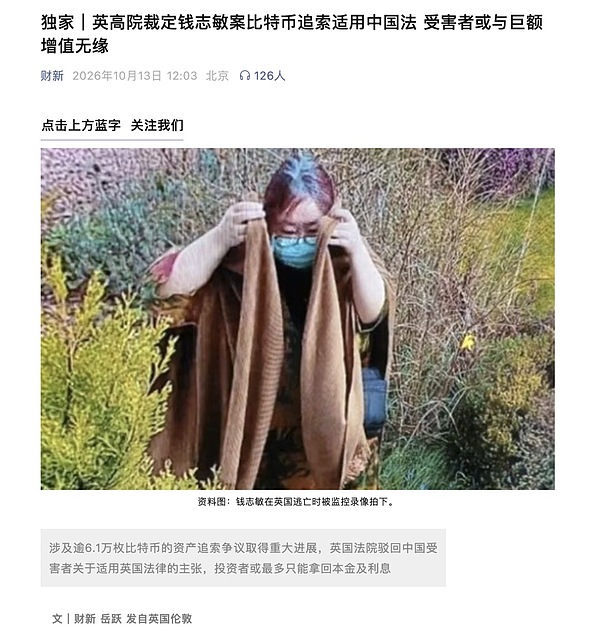
The applicant originally hoped to use English law to protect their rights to the assets in question. From the victim's perspective, they had paid real money, which was later converted into currency. Now that the currency has been found and appreciated in value, at the point of dividing the profits, the increased value may no longer be relevant to them.
Following the UK's ruling, new information has also emerged from within China.
On October 13, the Tianjin No. 2 Intermediate People's Court announced that it had accepted the application from the procuratorate to confiscate the illegal gains of Qian Zhimin, which involves assets such as approximately 61,800 Bitcoins.
Why should Chinese law be applied to a case in the UK?
From 2014 to 2017, Qian Zhimin organized and implemented an investment scam in China, with some of the funds being converted into Bitcoin. She later fled to the UK, where police seized her assets during an investigation. In November 2025, she was sentenced to 11 years and 8 months in prison for related money laundering crimes.
But for the victim, the criminal penalties she faces are probably less important than the fate of her assets, including over 61,000 bitcoins. For the victim, the hope brought by rising cryptocurrency prices is very real: they were initially worried the scammers wouldn't have the money to compensate them, but now the recovered assets are likely to be worth at least a fair amount.
Having money to distribute is one thing, but how much you can legally receive is another.
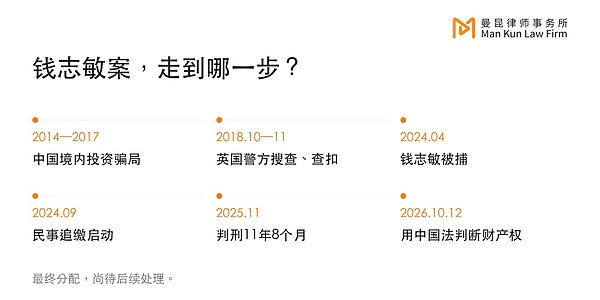
Key Timeline of the Qian Zhimin Case
There was a previous case in the UK called Foskett. Buyers paid for land in Portugal, with the funds supposed to be held in an express trust by a recipient—meaning the funds were held on behalf of the buyers and used for the agreed purposes. However, £20,440 was misappropriated to pay two premiums for a life insurance policy. After the insured's death, the insurance company paid out approximately £1 million. The buyers demanded a share of the insurance payout in proportion to their premium contributions, but the beneficiary objected.
In 2000, the UK House of Lords supported the claim that homebuyers should share insurance proceeds proportionally. They were able to claim the proceeds because they had a property right in the original trust funds, and this right could be traced back to the insurance payout. This also explains why the applicants in the Qian Zhimin case wanted to claim their share of the assets. However, whether a similar outcome can be achieved depends on whether the rights they acquired when they made the payment can be extended to Bitcoin.
The victim naturally wants to reclaim their share of the assets, not just the 100,000 yuan they received years later. This is understandable. The legal challenge lies in proving that "the assets were purchased with my money" and then demonstrating that "I still have a right to these assets."
The individual applicant in the Qian Zhimin case followed the path of confirming property rights.
They filed their application under Section 281 of the Proceeds of Crime Act 2002 (POCA) to exclude assets that legally belong to them from the scope of state civil seizure.
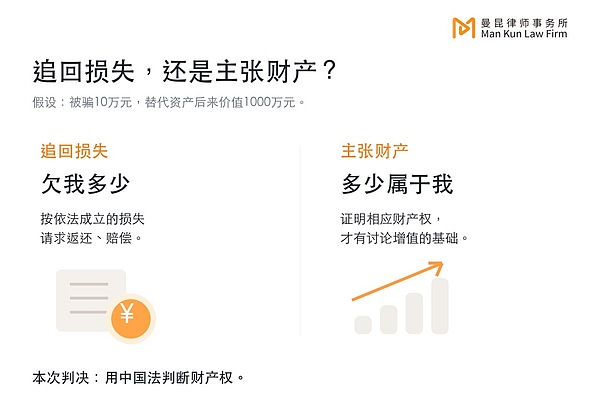
Recovery of losses and assertion of property share
The homebuyers in the Foskett case were able to share in the insurance proceeds under a crucial premise: the purchase money was originally held by the recipient in an express trust, and the homebuyers had property rights to this money.
In the Qian Zhimin case, the key steps in the investment and fund conversion occurred in China. Investors received promotional materials and paid in RMB in China; the money entered Chinese accounts and was then converted into Bitcoin.
To confirm whether any of these coins belong to investors, we need to look back at what rights were established after the initial payment. Once the money is in the UK, the original investment relationship cannot be directly transformed into a trust relationship like the Foskett case.
If all transactions established in China were treated under English law simply because the fraudster later went to the UK, the rights to the same investment could change depending on the fraudster's whereabouts. In this case, the UK court did not accept the applicant's argument for either English substantive law or a hybrid application of Chinese and English law, but instead chose to apply Chinese law. This choice of applicable law does not mean the case has been transferred to a Chinese court; the UK court will still handle the civil recovery and related applications according to its own procedures.
The next step for the victims is to prove their rights under Chinese law, rather than continuing to discuss what remedies English law can offer. However, the ruling did not conclude that everyone is left with only principal claims; the specific content and effects of Chinese law remain to be determined in subsequent stages.
Why does the report say that victims may not receive the huge increase in value? Let's first look at the common handling methods in the recovery and restitution of stolen assets in China.
The Supreme People's Court's regulations on the enforcement of the property-related portions of criminal judgments require, on the one hand, the recovery of assets and profits derived from investments made from embezzled funds; on the other hand, they stipulate that restitution or compensation to victims should be calculated based on the actual losses determined in the criminal judgment. If assets have appreciated, more property can be recovered; however, the amount of restitution based on actual losses will not be calculated using multiples of currency appreciation.
Let's revisit the hypothetical scenario: you were scammed out of 100,000 yuan, but your assets have grown to 10 million yuan. If you can claim the 100,000 yuan loss, then recovering 10 million yuan means you can afford to pay it back, not that the money owed to you has become 10 million yuan. As for other losses that should be compensated, there must be corresponding legal grounds. The market appreciation of Bitcoin cannot be directly considered as additional losses for the victim.
To share in the appreciation, the applicant needs to further prove that they legally own a share of the assets within these coins. If this property right is established, the claim is for the asset value corresponding to that share, and only then can the appreciation potentially be attributed to that share. This is why the applicant cited the Foskett case, hoping to apply English law. Now, the English court is demanding that Chinese law be used to determine this property right, thus thwarting the original argument for securing a share of the assets under English law. Finding a basis under Chinese law has become the key next step.
However, domestic criminal restitution regulations cannot directly determine for the British courts how to distribute this batch of currency.
Tianjin has initiated confiscation proceedings; is it possible to get the money back?
According to The Paper, the Tianjin No. 2 Intermediate People's Court accepted the application filed by the Tianjin Municipal People's Procuratorate No. 2 Branch on September 28 to confiscate illegal gains, including 61,896.41552945 Bitcoins, as well as other virtual currencies, cash, jewelry, and financial assets.
The prosecution's application revealed that Qian Zhimin, who effectively controlled Lantian Gerui, used fraudulent financial products to attract funds, causing losses to over 102,000 investors. The prosecution argued that all illegal gains, converted assets, and accrued interest should be included in the recovery process, and in addition to the portion legally returned to the affected investors, the proceeds should be confiscated. This is the prosecution's application and accusation; the court has accepted the application but has not yet issued a final confiscation ruling, nor is it a ready-made distribution plan.
Why is this procedure noteworthy? The Criminal Procedure Law stipulates the procedure for confiscating illegal gains in cases where the suspect or defendant has absconded or died. Under certain legal conditions, the property can be examined first, without having to wait until the ordinary criminal trial of the suspect is completed. This announcement corresponds to this special procedure. Qian Zhimin's conviction in the UK for money laundering and the handling of his assets related to suspected fundraising fraud in China address different issues.
The term "confiscation" should not be interpreted as meaning all of the victims' money will be taken to the national treasury. Article 300 of the Criminal Procedure Law excludes the return of property to victims from confiscation, and the Tianjin prosecutor's application also retains the right to return the money to those who suffered losses in the fundraising scheme. What truly needs to be examined is which assets should be recovered, which should be returned, which constitute other confiscable assets, and how the losses of each participant should be assessed. The recovery of assets, the return of money to victims, and the confiscation of remaining assets each have their own legal conditions.
If the Tianjin court accepts the case, will the British currency automatically return?
It also involves cross-border assistance and asset transfer. Articles 47 to 49 of the International Criminal Judicial Assistance Act stipulate the pathways for requesting the confiscation and return of seized property from foreign countries, including submitting requests, proof of ownership, and legal instruments, as well as negotiating the transfer of property. Domestic rulings can provide legal instruments and factual basis for subsequent requests. Whether assistance can be obtained in the UK, and how it will be coordinated with local recovery procedures, still needs to be handled in accordance with UK law and applicable assistance mechanisms. It is incorrect to simply state that domestic case filing implies a repatriation arrangement has been reached between the two countries.
For victims, this means distinguishing between two claims: For domestic refunds, the focus is on proving their investment and unrecovered losses; for UK claims seeking confirmation of a specific Bitcoin share, proof of property rights under Chinese law and how those rights transferred from the original investment to the seized assets is required. Transfer receipts can prove that the victim made payments, but they may not solely prove ownership of certain cryptocurrencies. Contractual agreements, receiving accounts, recovered funds, and records of funds being converted into Bitcoin can all influence the assessment. Both procedures also require accurate disclosure of the amount already recovered; the same loss cannot be counted twice.
The announcement also provided a very practical piece of information: affected investors can apply to participate in the litigation through the WeChat mini-program "Tianjin No. 2 Intermediate People's Court Interested Parties Litigation Platform"; not participating in the litigation will not affect their right to receive refunds from the recovered assets. The announcement period is six months, after which the case will be heard according to law. This domestic arrangement cannot be directly extrapolated to mean that applications in the UK are unnecessary, nor can it guarantee full compensation after registration in China.
For ordinary participants, the most important thing to do right now is to clarify the basis for their property rights and the whereabouts of their funds under Chinese law, and to compile records of investments, repayments, and previous liquidations. "Principal and interest" requires specific evidence; the returns promised by illegal fundraising projects cannot be directly considered as interest payable.
How much the price of a coin rises is a matter of asset market conditions; what the law truly addresses is how much can be claimed.
Source:Global Cybersecurity Alliance (GCSA)
Website:www.gcsa.org
Berlangganan berita, langsung ke email
Kami menghormati privasi Anda. Lihat Kebijakan privasi