Seven lines of code to integrate payment, eight APIs to break down banking
On September 29, 2026, Stripe published a lengthy article outlining its stablecoin product stack, breaking down what a bank could do into eight product modules, from card issuance and payment processing to fund management, all the way down to issuing the US dollar itself. A few days later, it put the founder of the crypto wallet company Privy in charge of the entire crypto and stablecoin business.
The neobanks we were familiar with before broke down banks into front-end and back-end operations, with the front-end handled in-house and the back-end outsourced to partner banks. Now, in the era of blockchain and AI, Stripe has broken down the back-end into individual modules, and with the help of blockchain, anyone can build a bank.
On September 25th, the creator platform Whop launched a neobank template, claiming that a new account could be opened in just 15 minutes. Nubank acted even earlier, entering the US market on September 10th, launching without its own license yet by leveraging stablecoins from partner banks Lead Bank and Circle. Previously, Nubank had taken thirteen years from its establishment in Brazil to obtaining a banking license.
In the era of blockchain and AI, it seems like everyone can build a bank. However, our observation is that no one is born a neobank. It's either about starting from a specific point and expanding to a broader scope (Nubank started with local lending) or starting from a broader scope and expanding to a specific point (Crypto was born globally and then expanded geographically).
The real questions to consider are: Where exactly has Neobank lowered its barriers to entry? Once broken down, how does each layer of the stack generate revenue? At what stage should the company be positioned within that layer? And in the future, once agents begin trading on behalf of others, will value capture fall into Neobank's hands?
There's a Jevons paradox in economics: the higher the efficiency, the greater the usage. Neobank is following the same path, from having to visit a branch to open an account to an app that only handles front-desk transactions and outsources deposits and clearing to partner banks. Every time the cost of serving one person decreases, a new group of people who were not previously served by banks come in.
The two most successful companies today have each captured a unique customer segment:
Nubank started in 2013 by targeting people with no credit history in Brazil, initially offering free credit cards, and then gradually adding accounts and loans. It took thirteen years to obtain a banking license.
Revolut started in 2015 with cross-border currency exchange and prepaid cards, initially using a Lithuanian license to cover Europe, and it took eleven years to obtain a full license in the UK. One started with credit, and the other with cross-border, both following a path of starting light and gradually building up, supplementing their operations as they go.
Neobank, which is based on blockchain and stablecoins, is also known in the industry as crypto neobank. Stablecoins don't change the "lease-to-pay" model, but rather the scope of what can be leased:
From a local bank, it has expanded into a complete suite of global, programmable financial capabilities.
When analyzing the stablecoin market in April 2026, a16z crypto made a distinction: the previous wave of Banking as a Service involved Fintech companies renting banking licenses and accessing core banking systems; this wave allows companies to build directly on on-chain infrastructure and self-custodied wallets, combining accounts, payments, wealth management, currency exchange, and credit into complete products.
The changes occur in two places:
The USDC that users deposit in the stablecoin Neobank is Circle's liability, not Neobank's deposit. The heaviest burdens, such as deposit licenses and capital adequacy, remain with the issuer along with the liability.
The account is recorded on the public blockchain, and the unit of account is US dollars, which can be transferred across borders and is not restricted by the business hours of traditional banks. Only the fiat currency inflow and outflow requires a local partner.
Stablecoins and Stripe are to Neobank what AWS is to internet companies: turning what used to be self-built infrastructure into readily available services. Stripe started by allowing merchants to integrate payments with seven lines of code; now it breaks down banks into eight APIs.
AI is reducing another type of cost. Félix brought cross-border remittances into WhatsApp, eliminating the need for users to download an app; Nubank used financial behavior data from approximately 135 million users to train models that predict defaults. Going a step further, software is beginning to initiate transactions on behalf of customers, leading to a new set of authorization relationships.
Following Jevons' logic, the outcome is not hard to predict: neobanks will open more and more branches, covering an increasingly wider population. With so many people able to open branches, the problem shifts from whether it's even possible to do it, to where they can make money.
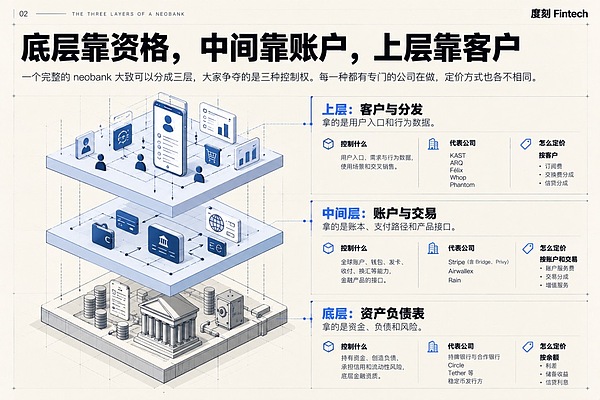
A complete neobank can be roughly divided into three layers, and the competition among them is for three types of control.
The bottom layer controls the balance sheet: who holds the funds, creates liabilities, and bears credit and liquidity risks. The middle layer controls accounts and transactions: who controls the ledger, wallets, payment paths, and product interfaces. The top layer controls customers and distribution: who controls user entry points, demand and behavioral data, usage scenarios, and cross-selling.
Nubank and Revolut spent ten years acquiring all three levels of control; now each level has its own specialized company, with different pricing methods. How much value a company can extract depends on how many levels of control it holds and whether others can easily replace it.
Revolut's profit and loss statement reveals what it's like to have three types of control in one company. In 2025, it generated £4.5 billion in revenue and £1.7 billion in pre-tax profit; it controls the balances, transactions, and cross-selling revenue from a single customer. While many established banks derive over 70% of their revenue from interest, Revolut derives three-quarters from fee income. Nubank, on the other hand, focuses more on the fundamentals, with $16.3 billion in revenue and $2.9 billion in net profit in 2025, backed by a $19 billion credit portfolio supported by $41.9 billion in deposits.
With all three tiers in place, Nubank and Revolut can extract more complete revenue from a single customer, while reducing the outflow of value to partners. High profits, of course, also depend on customer scale, customer acquisition costs, bad debt control, and interest rate spreads in the market. However, if these three tiers are distributed among different companies, each tier takes a cut, with middlemen profiting from the difference.
Let's compare these same income streams; when they reach the stablecoin Neobank, they flow to different layers:
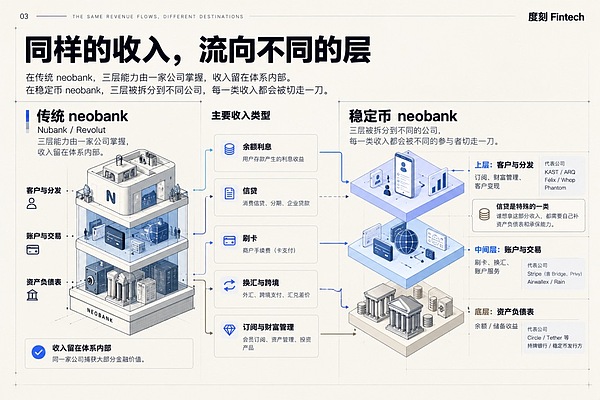
It is important to note that while the threshold for assembling banking capabilities has been significantly lowered, the threshold for managing financial risks has not decreased accordingly. The burdens of funding, credit, compliance, and repayment have not disappeared; they have simply been transferred to issuers, partner banks, and various service providers.
Issuers bear the burden of redemptions and reserve management; the middle layer faces price competition after scaling up; and the upper layer bears the costs of customer acquisition, customer service, and fraud losses. Credit also needs to deduct funding costs, bad debts, and capital occupation. Revenue attribution does not equal final profit. We cannot only look at who pockets the revenue, but also who pays the costs, who bears the risks, and who ultimately has the final say.
The underlying control determines where the funds initially end up. It has two sides: fiat currency banks on one side and stablecoin issuers on the other.
On the fiat currency side are licensed banks, which accept deposits, have direct connections to local clearing, and are protected by deposit insurance. Lead Bank and Cross River, which back many crypto neobanks, belong to this category, as do Nubank and Revolut, which also hold their own banking licenses here. Over the past decade, partner banks have been the biggest weakness for crypto companies; relationships are difficult to build and easy to lose. Now, a group of crypto-friendly banks are filling this gap.
On the stablecoin side are issuers like Circle and Tether, who receive US dollars, open stablecoin accounts instead of bank accounts, and then build an on-chain dollar ecosystem on top of them, which can be called on-chain dollar banks.
Both sides profit from the interest rate spread between deposits and loans, or similar deposit-loan transactions. Lowering the entry barrier hasn't disadvantaged this layer. Simon Taylor, Head of Market Expansion at Tempo, wrote in the company's 2025 annual report, "State of Fintech 2026":
The year 2025, when stablecoins and academia commerce were at their peak, did not disrupt banks; instead, banks had a record-breaking year.
However, the balance is not the same thing. Fiat currency deposits, escrowed customer funds, stablecoin reserves, and user assets in wallets have different legal attributes, and only a portion of them can be used for lending.
However, the two sides are converging. On the issuer side, Stripe's Bridge received conditional approval from the OCC National Trust Bank in February 2026. Once fully approved, it can custody digital assets, issue stablecoins, and manage reserves. While the trust license cannot accept deposits from depositors, it puts issuers inside the banking system. According to a16z, this licensing race is about where they will sit in the payment system in the future: if regulators allow licensees to directly connect to the Federal Reserve's clearing system, issuers who obtain licenses early will be at the core of the financial system.
Banks are also moving towards stablecoins. SoFi, holding a banking license, issued SoFiUSD in December 2025, claiming to be the first stablecoin issued on a public blockchain by a US national bank.
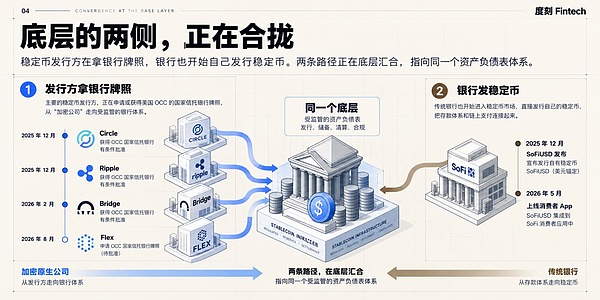
The distinction between the bottom layer and the middle layer lies in whose balance sheet the money is recorded on: the bottom layer consists of the holders of the money, while the middle layer consists of those who organize these capabilities into accounts and sell them through APIs. What the bottom layer cannot easily replace are licenses, liquidation qualifications, and low-cost sources of debt.
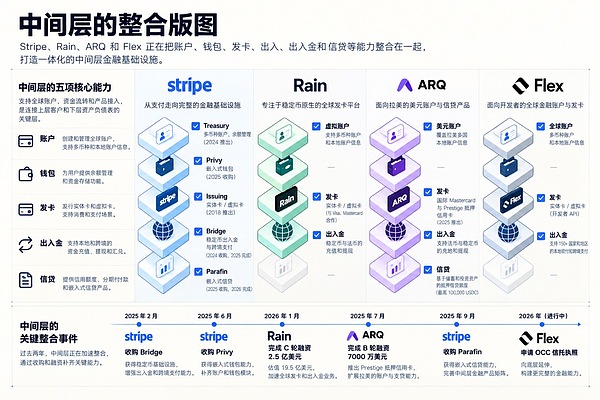
The middle layer is vying for global accounts. An account that can deposit, pay, receive, and exchange currency can be layered on top of that for wealth management, consumption, and borrowing.
Stripe has placed accounts at the heart of its strategy. Henri Stern, the Privy founder mentioned at the beginning, said when he took over Stripe's crypto and stablecoin business on October 5th that wallets are the center of digital ownership, but they only have power when combined with orchestration, card issuance, and asset distribution. Stripe now refers to Treasury as an account layer for global financial products, allowing businesses to hold both fiat currency and stablecoins in one account and make payments to 160 countries using only an email address.
Once the accounts are in hand, the middle layer starts competing at both ends. Upwards, it competes with the upper layers for cross-selling. On September 30th, Stripe announced its acquisition of Parafin, which allows platforms like DoorDash and Gusto to lend to merchants through its backend, having already disbursed over $3 billion in loans. Ironically, Parafin's selling point in the past was precisely its independence from payment providers.
Downstream, it competes with the underlying infrastructure for balances. Rain started by issuing stablecoin cards, then added virtual accounts and deposit/withdrawal functionality, and attempted to directly connect to ACH and SEPA. It is pushing issuing banks, project managers, and processors into the same infrastructure to capture more exchange fees, currency exchange rate spreads, and reserve returns.
The more platforms the middle layer connects to, and the more comprehensive the services linked to the account, the harder it is for customers to migrate. It wants to profit from cross-selling at the upper level, and also wants to capture the balance revenue at the lower level.
At the top level, it's all about who gets the customers first. Two paths have emerged: companies like KAST and ARQ treat finance directly as a product; platforms like Whop integrate finance into their existing businesses. Simon Taylor's report mentions that Robinhood, Klarna, and Affirm are also using credit cards as a growth driver; everyone wants to be a neobank.
Among the former, KAST, ARQ, and Félix are the fastest growing. Félix, for example, serves Latin American immigrants in the US, with remittances completed via WhatsApp and settled in USDC. After securing credit lines, it expanded into savings and consumer loans. KAST started with stablecoin accounts and cards, while ARQ began with USD accounts in Latin America; both are expanding into credit and wealth management.
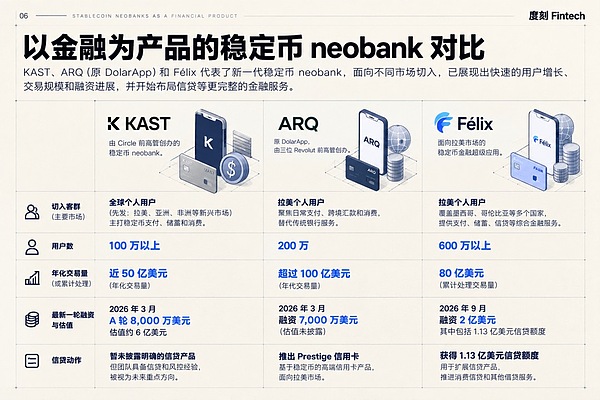
A USD account is just the entry point; you earn money after opening the account. Once a user has a stable USD balance, credit, investment, wealth management, and insurance can all be accessed one by one.
All three companies follow the same path: acquiring customers through global accounts and then monetizing through financial services, with local lending being the most valuable component. While the main components of global USD accounts are highly rentable, local deposits and withdrawals, compliance, and clearing are not yet standardized. Capital can also be rented out in stages—credit lines, securitization, and partner banks are all methods. What cannot be rented is local underwriting capacity validated through a complete credit cycle, and low-cost, sustainable customer relationships. Lending is not difficult; making money through economic cycles is.
a16z's assessment also points to this: payments are the first act, and credit is likely the second. Once the float of stablecoins reaches trillions of dollars, this money will eventually need to find a place to be used, and a new credit market will inevitably emerge on the blockchain sooner or later.
The latter is exemplified by Whop. Originally a digital marketplace for creators, it settles approximately $3 billion annually for sellers. By making the final settlement point a platform account, the money remains on the platform, where it can be converted into stablecoins, invested in wealth management products, or spent via credit card. Whop began profiting from the retention and flow of funds. Phantom, Remote, and Shopify are also embedding finance into their existing products; in Latin America and Southeast Asia, MercadoPago and Grab have already taken similar paths.
While functional neobanks are rapidly expanding, the costs are clearly stated in their terms and conditions. Lex Sokolin of Fintech Blueprint analyzed Whop's terms of service: it is not a bank itself, and its liability is capped at 12 months' fees or $100; the wallet comes from Privy, the card is issued by Third National and managed by Rain, and the balance is deposited into Aave through Veda Vault to earn interest; fiat funds are held in a hybrid escrow account with a partner bank, not covered by FDIC insurance, and use the same structure that led to Synapse's bankruptcy in 2024.
Lex Sokolin's conclusion is straightforward: positioning is cool, but it can also be dangerous. Banking is ultimately a business of managing risk.
Regulators have also taken note of this structure. A Federal Reserve study in April 2026 pointed out that when a stablecoin's operating chain consists of multiple third parties, the market may not be able to pinpoint the source of the pressure when problems arise, potentially amplifying panic during a crisis.
What is irreplaceable at the upper level is customer trust, scenarios, data, and low-cost distribution.
There is no single answer to where a company should stand.
In the early stages, rent as much as possible to prove that you can retain customers; once you've scaled up, take back the links that have the greatest impact on profits, data, and even survival.
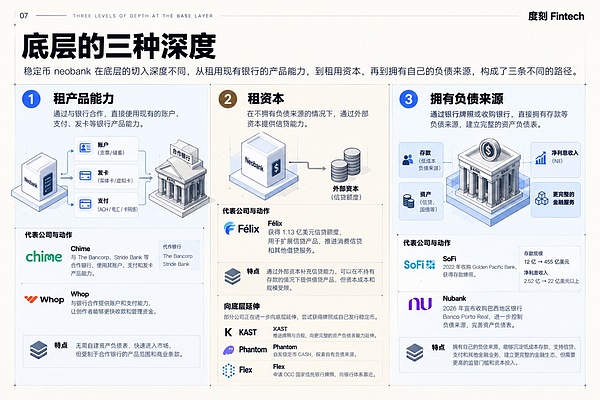
In their early stages, companies typically rent the lower and middle tiers of the leased space, focusing solely on the upper tiers and targeting a single customer base before launching. Today's stablecoin Neobank largely operates this way, and it started in the same manner. Chime, to this day, doesn't have its own banking license; its accounts are held by partner banks, and it primarily earns money through credit card exchange fees. Profit margins are thin, but its rapid growth is a significant advantage.
As for which layer to reclaim, it depends on the company's core strengths. How much profit the partner takes is one factor; whether the company can survive if the partner cuts off funding is another. For companies that make money through lending, the answer is usually the bottom layer; for a distribution platform like Whop, a banking license may not be necessary; whether the middle layer should also engage in lending is another matter. Reclaiming key links doesn't necessarily mean being as full-stack as possible; only when the gains in profit, data, and stability outweigh the costs of capital and regulation is cross-layering worthwhile.
SoFi is the clearest example. In 2022, it acquired the small bank Golden Pacific, obtained a national banking license, and began lending using its own deposits, resulting in a more than 30-fold increase in deposit size. Nubank acquired Banco Porto Real in 2026, following the same path.
There are varying degrees of integration at the underlying levels. Leasing product capabilities, leasing capital, and then having a stable, low-cost source of debt represent three different levels of integration. Félix has reached the second step, while SoFi and Nubank have reached the third.
Nubank and Revolut have reached maturity, holding all three types of control in their core markets. But when entering a new market, they have to make choices again. Nubank's choices this year best illustrate this: in the US, it rapidly expanded using Lead Bank and Circle; in Brazil, it only acquired the missing banking license; and in the UK, in September, it abandoned negotiations to acquire Monzo, a fully-fledged three-tiered digital bank, for £8 billion to £10 billion.
Nubank's most valuable asset is its customer base and underwriting capabilities accumulated in Brazil, an advantage that may not be easily replicated in the UK. When entering a new market, even established companies need to recalculate: which capabilities should be leased, and which should be acquired.
Another unavoidable question is: Nubank and Revolut can also add stablecoin accounts themselves. Revolut launched the Euro stablecoin EURR, which was issued by Bridge, in August 2026. Nubank created Nu Global. What makes the next generation of stablecoins still have a chance?
The answer lies in the customer base. What we've observed is that established neobanks are moving upmarket, increasing the value per customer and extending into wealth management and high-end services; stablecoin neobanks are targeting those with the strongest demand for cross-border USD payments but the worst service from the old system. ARQ serves USD savings in Latin America, Félix serves remittances for immigrants, and KAST targets those lacking a convenient USD account. Both sides will gradually converge, but it's much cheaper for new players to start. The time it takes for licensed neobanks to enter a new market may have already covered the initial startup phase.
The boundaries are not static either. Stripe extends downwards using trust licenses, Bridge, and Parafin, while reaching customers upwards through its more than 300 million Link users.
If the threshold is lowered another level, it won't just be people initiating transactions anymore. Once personal AI starts shopping, ordering services, and paying per transaction on behalf of people, the financial system will have to handle a new type of agency relationship: the account still belongs to the person or company, and the agent initiates transactions within the scope of authorization; it is not a new legal entity itself.
This delegation relationship spans three levels of control. The user's intent originates from the AI product, is translated into permissions and transaction instructions by intermediaries like Stripe and Link, and finally, the bank or issuer decides whether to accept and settle the transaction. If problems arise, responsibility still falls back to law and contract. Authorization is most likely to become a new battleground for control between the intermediary and upper layers: AI companies want to hold onto user intent and long-term authorization, while Stripe, Link, and Catena want to transform authorization into verifiable, enforceable, and traceable financial credentials.
Simon Taylor of Tempo says that every AI company will become a payments company. That's a somewhat overstatement, but the direction is correct: once AI starts taking actions for users, payments are unavoidable; whether or not they handle it themselves is another matter. Meta Muse uses Stripe Link and one-time virtual cards to settle payments for users, and later connected to Shop Pay and PayPal; Stripe and Tempo have launched machine payment protocols that allow agents to pay directly for data, computing power, and software tools. AI companies grasp user intent, but payment capabilities are mostly rented from intermediaries. Stripe's role is to provide agents with a secure way to access user funds and payment credentials.
The competition hinges on whether AI companies grasp only the user's intent or go further and seize control of identity, payment credentials, and account relationships.
Another approach involves licensed institutions directly handling identity, authorization, and settlement in agent transactions. Catena Labs aims to create a financial identity for each agent, linked to the individual or company behind them. These individuals or companies would first set spending limits, recipients, and balance limits before delegating execution to the agents. On September 18, 2026, the OCC granted Catena Trust Bank preliminary conditional approval. Catena's goal is to build a comprehensive financial delegation system encompassing entity identity, authorization scope, policy restrictions, transaction execution, and accountability. Whoever controls identity, authority, and transaction credentials may become the new value node in the agent era.
The banking industry is also doing the math. Oliver Wyman believes that by 2030, agents will become the dominant customer acquisition channel.
When an agent starts spending money on behalf of others, who holds the funds, payment vouchers, and authorization rules? Is it the AI company, Stripe's Link, or a financial institution like Catena?
This competition is about who can securely transform human authorization into transactions that machines can execute and that are subsequently traceable. Simply providing the agent with a wallet doesn't guarantee a win.
Blockchain and AI reduce the cost of assembling financial capabilities and serving customers, but they do not simultaneously lower the barrier to managing financial risk. Value therefore falls into three areas of control: balance sheets, accounts and transactions, and customers and distribution.
In the initial stages, rent what you can first; once you've scaled up, take back the crucial elements that determine profits, data, and even survival. When entering a new market, you have to choose again. Agents have turned authorization into a new battleground: whoever holds the user's intent, payment credentials, and account relationships may become the new gateway between people and the financial system.
Rethinking neobank might eventually render the term obsolete. Ten years ago, it referred to a type of company: a bank without branches, operating solely through its app. Today, creator platforms, social media companies, payment companies, and even AI that spends money for people are all doing what neobank does. When every product with users can spawn a bank, neobank ceases to be an industry and becomes a capability.
Everyone can be a neobank, but eventually, neobank may disappear from the product itself.
Source:Global Cybersecurity Alliance (GCSA)
Website:www.gcsa.org
Get updates in your inbox
We respect your privacy. See our Privacy Policy