Author: Xiaojing, Tencent Technology
With its Jev model, which neither talks nor writes code, AI startup TypeSafe AI has attracted significant investment from top Silicon Valley firms.
On October 9th, US time, TypeSafe announced the completion of an $870 million Series A funding round, bringing its post-money valuation to $7.5 billion. The round was led by a16z, with participation from Sequoia Capital and DCVC. Martin Casado, a partner at a16z, will join the company's board of directors.
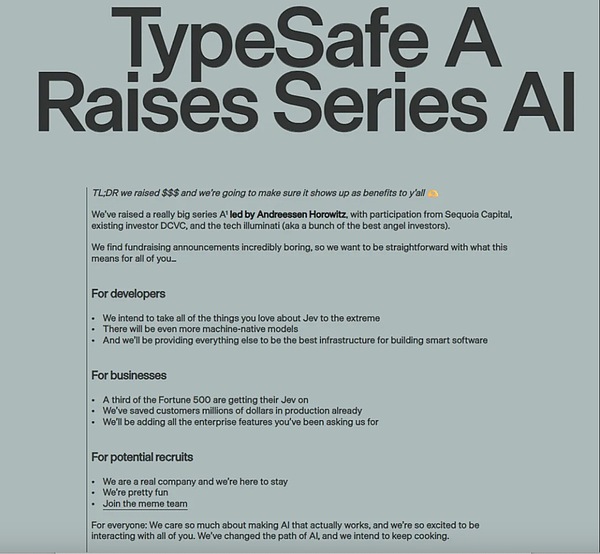
DCVC had previously led a seed round funding for TypeSafe. The investment announcement for a16z was jointly signed by several partners, including founding partners Marc Andreessen and Ben Horowitz.
Jev opened early access on September 15, and from product launch to completing a new round of financing, it took less than a month.
Why is capital betting on Jev?
a16z's investment announcement called Jev's release"the biggest narrative comeback of the year."
While the entire industry is chasing larger models, longer contexts, and deeper inference, TypeSafe has gone against the grain, creating a simpler, faster, and cheaper model, which has actually led to faster growth.
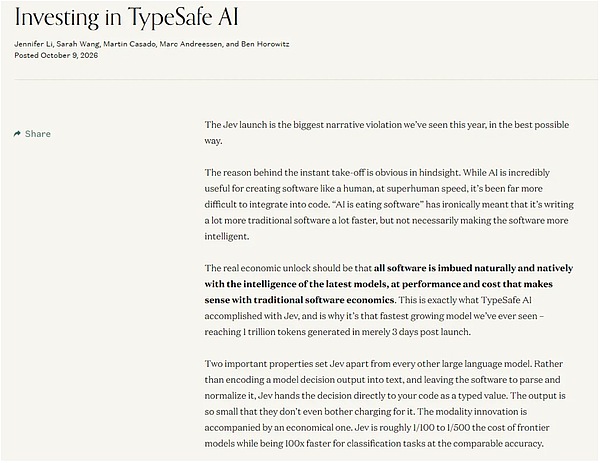
Behind this is a16z's assessment of the current state of the AI industry: "AI is eating software" has been a popular saying for years, but the reality is somewhat ironic—AI is indeed writing more traditional software, and faster at it, but it doesn't necessarily make the software itself more intelligent.
Large models are powerful as dialogue assistants, but to integrate them into existing software, developers have to do a lot of work on format conversion and exception handling.
a16z believes the real economic breakthrough lies in the fact that all software can naturally and natively embed the intelligence of the latest models, while maintaining performance and cost in accordance with the economic principles of traditional software.
This is what impressed them about TypeSafe. Jev isn't just another chatbot; it's a decision-making component that can be directly written into code. Casado described this need as a "hole shaped like Jev." Developers had always wanted to do AI-driven decision-making within the software, but previous tools were too cumbersome. It wasn't until Jev came out that everyone realized this was exactly what they needed.
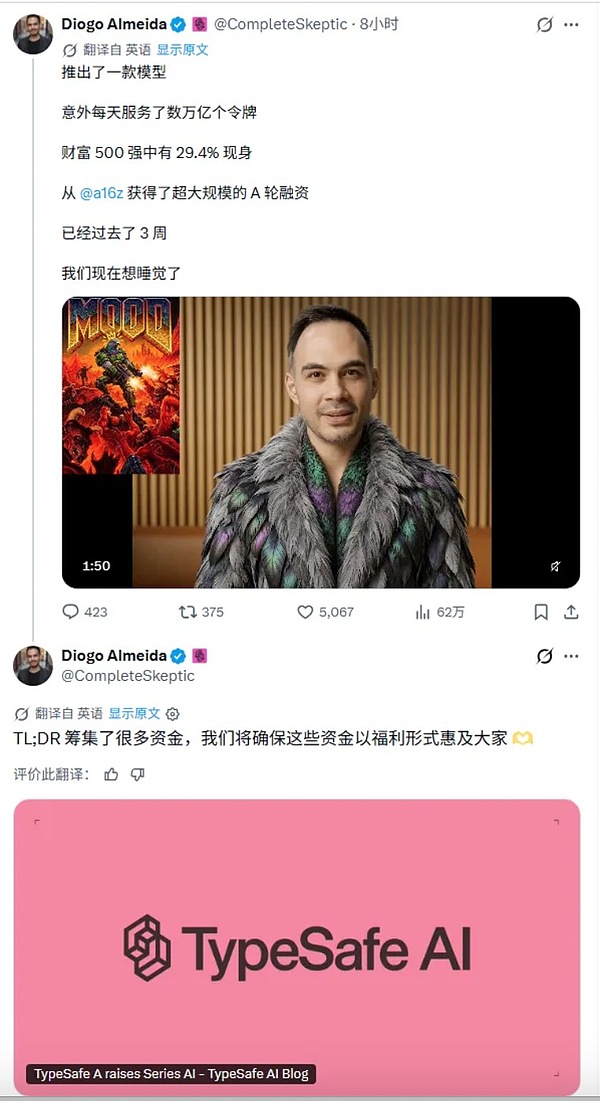
Growth data is the most direct support for valuation. TypeSafe disclosed that Jev processed 1 trillion tokens in just three days after its launch, and thousands of application scenarios emerged in the first week, covering areas such as generative interfaces, interactive games, and data analytics. a16z stated that this is the fastest-growing model they have ever seen.
Enterprise penetration was equally rapid. Within days of its launch, Jev had over 1 million users, and approximately one-third of the Fortune Global 500 companies were already using the model.
a16z also compared TypeSafe and Cursor. Cursor allows developers to write more software faster using AI, while TypeSafe allows developers to write smarter software at a lower cost. One changes the way software is written, and the other changes the way software itself is structured. They have different entry points, but both represent the deep integration of AI and the software development process. a16z was an early investor in both deals.
Furthermore, a16z believes that TypeSafe and developer culture are highly compatible in spirit: pragmatic, composable, and respectful of builders. This contrasts sharply with the rhetoric of large labs that "replace software engineers" and "kill SaaS."
TypeSafe believes that AI is a tool to make software smarter, not something that will replace it, and that power should return to the developers. a16z says this shared philosophy dates back many years, and they have been following founder Diogo Almeida for a long time.
There's also the logic of the "Jevins Paradox" here. Jev's name comes from economist William Stanley Jevons, who proposed that efficiency improvements can actually increase demand. a16z applies this logic to AI: if intelligence is cheap enough to be used everywhere, it will be used everywhere. Increased usage leads to even greater overall revenue potential.
The new demand brought about by Jev is another reason why a16z is willing to give it a high valuation at such an early stage.
It's worth noting thatJev became profitable quickly after its launch. Almeida confirmed this in an interview, though the company didn't disclose specific figures. A team of just over twenty people achieving profitability in less than a month demonstrates that the business model itself is sound, and growth isn't achieved through subsidies and burning cash. This supports the $7.5 billion valuation—at least it's not purely based on a story.
How should I spend the money?
The $870 million in funding will primarily be used for several purposes: further enhancing Jev capabilities, releasing more machine-native models, improving enterprise-level infrastructure and customer functionality, expanding the team, and increasing computing power. Currently, the company only has about twenty employees; to support a client base of Fortune 500 companies, additional staff are needed in R&D, deployment, and customer support.
The biggest challenge is reliability. Almeida himself said that the intelligence of many current AI models is fragmented—most of the time it is very high-level, but occasionally it is very low-level. In chat scenarios, problems can be followed up and corrected manually, but in unattended software processes, a single error can have a cascading effect on subsequent operations. Jev's structured output reduces uncertainty at the format level, but the accuracy and reliability of the judgments themselves remain independent issues.
Another challenge is the breadth of application scenarios. Currently, Jev is best suited for tasks with well-defined boundaries, such as classification, filtering, and scoring, but software judgments go far beyond these. TypeSafe needs to prove that its methodology can cover a sufficiently wide range of needs in order to evolve from a useful tool into an infrastructure-level product.
Talent recruitment platform Jack & Jill provides a specific example: switching the entire candidate matching process from Gemini to Jev within 10 days reduced costs by 88%, halved processing time, and saved $265,000 annually.
Ambitions for composable AI
Almeida had previously worked on the development of InstructGPT at OpenAI and was one of the builders of the core technologies behind ChatGPT. However, he later chose to leave and take a completely different path.
His core judgment is that computers don't speak human language. Software is composed of logic, data structures, and layers of abstraction. If AI is to be integrated into software, it should become a directly callable component, not a conversational assistant.
TypeSafe calls this concept "Composable AI"—replacing software engineering is not the goal; they hope to break down intelligence into independently callable components, allowing developers to assemble them themselves.
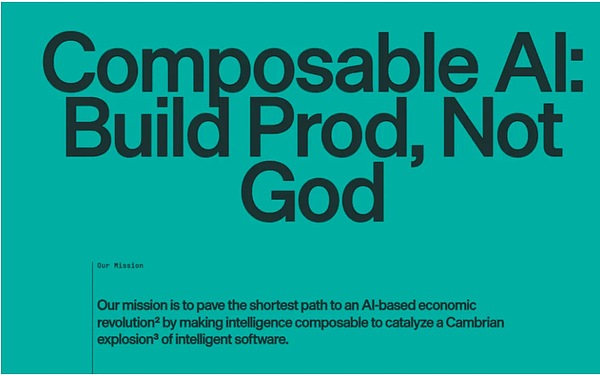
The company's website uses the metaphor of a "horse-less carriage": early automobiles followed the design of horse-drawn carriages, only replacing the horses with engines before finding their original form. Today's AI is similar, still in the old form of a "talking assistant." TypeSafe aims to design models from the outset according to the needs of machine calls.
This is Almeida's gamble, and the underlying logic behind the $870 million investment in a16z. Jev is just the first step; the System One model series will have many more members. The $7.5 billion valuation is buying into whether the possibility of "intelligence becoming a fundamental software component" can become a reality.
If it succeeds, it will become the next database-level infrastructure; if it fails, it will just be a small model that sells well.
Source:Global Cybersecurity Alliance (GCSA)
Website:www.gcsa.org
Get updates in your inbox
We respect your privacy. See our Privacy Policy