We've been holding back, and we at Google are holding back a huge one!
While the Gemini 4 Argon is still awaiting full release, they've already secretly started testing a more powerfulCarbonversion internally.
Some employees even say that their coding performance is already on par withOpus 5.5!(Really?)
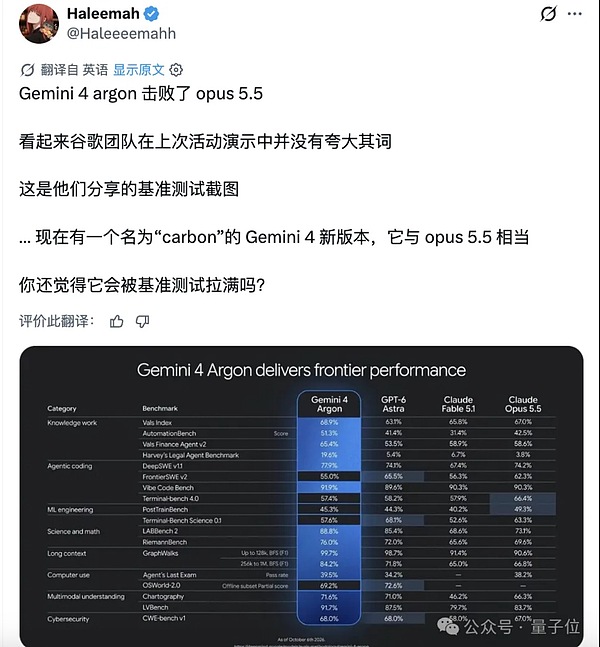
Moreover, let's leak it all, because Carbon is just one of the models leaked this time.
In addition to the officially announced Argon, Google has also internally identified several other research and development codenames, such as Barium and Carbon.
Argon, barium, carbon...
Before the Gemini 4 was even fully released, the periodic table of elements was already being flipped through.
Even more interestingly, eagle-eyed netizens have also discovered the whereaboutsof the Gemini 4 Flash!
A community user shared what appears to be a model identifier from the Google SDK: gemini-4-flash-preview, be like:
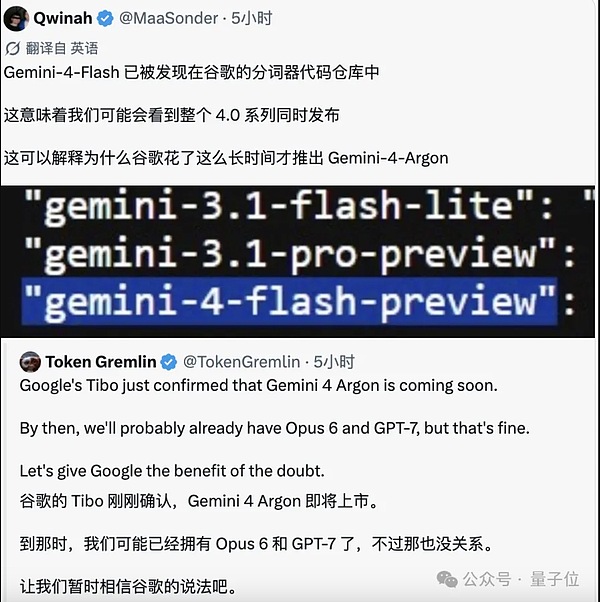
With the flagship model, a more powerful internal test version, and clues from the Flash series, this completes the Gemini 4 family.
We release, iterate, and internally test the next version simultaneously.
Who said the late bird catches no worms?!
A new internal version of Gemini 4 has been leaked, with employees claiming its coding capabilities rival those of Opus 5.5.
According to Business Insider, the Gemini 4 series has at least three internal codenames.
Argon: Google has officially announced the Gemini 4 flagship model.
Barium: A series of versions that previously participated in internal testing, among which Barium-B was ultimately selected as the public version of Argon.
Carbon: The latest version to enter internal programming testing has received positive feedback from employees.
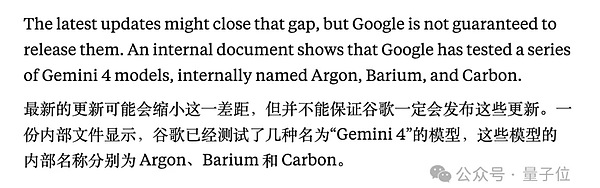
Let's take a look at this newly revealed model –Carbon.
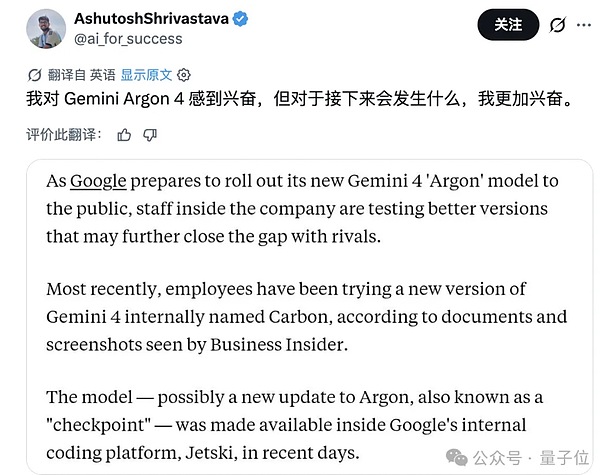
According to internal Google documents, employee chat logs, and related screenshots obtained by Business Insider, Google is currently conducting intensive testing of a new version of Gemini 4.
Carbon has recently been introduced into Google's internal coding platform Jetski for employees to try out.
As a result, even before its official debut, it garnered a wave of positive reviews from its own employees.
One employee who used it said thatfor programming tasks, Carbon felt almost as good as Claude Opus 5.5?
Another employee directly praised it in the internal chat channel:Carbon is really good!
Some employees also mentioned that a new Gemini Pro model with the "Next" label felt quite good to use.
It's important to note that "Next" here is a test label used internally by Google for updating some new models.
There's a small detail worth mentioning regarding the model relationships revealed this time.
There is no strict one-to-one correspondence between Google's internal development codenames and the final product names released to the public.
For example, Barium-B eventually became Argon.
This also suggests that Google may evaluate multiple candidate versions simultaneously during the internal testing phase and then select the model suitable for official release.
So whether Carbon will ultimately become an update to Argon or be released as another independent model in the Gemini 4 series remains to be seen.
However, there's a reason why Google employees would compare Carbon with Opus 5.5.
Because the information that BI unearthed this time also contained an early version of Argon's internal evaluation.
According to reports,while Argon received positive overall feedback from employees in its early stages, some testers felt that its experience on certain programming tasks still lagged behind Anthropic.
While Argon has achieved leading results on some software engineering benchmarks, it still lags behind Claude in tasks such as terminal operation.
For example, Argon scored 77.9% in DeepSWE v1.1, higher than Opus 5.5's 74.2% as officially listed. However, in Terminal-Bench 4.0, Argon scored 57.4%, while Opus 5.5 scored 66.4%.
The two tests involve different task types, which also reflects the differences in the practical engineering capabilities of cutting-edge models.
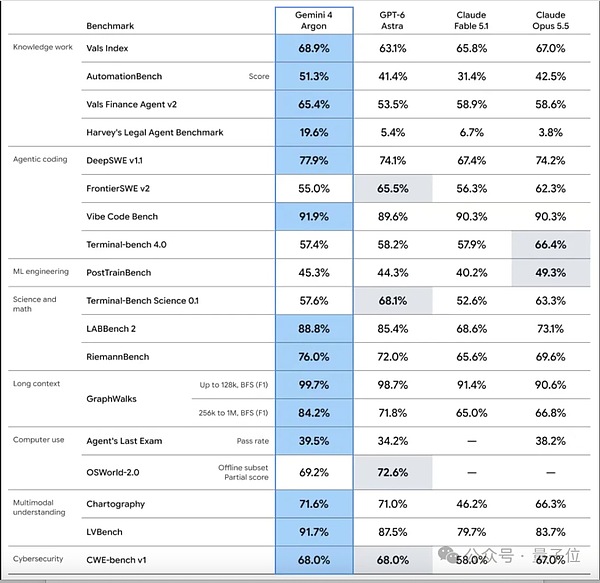
Now, internal feedback suggests that Carbon's programming experience is close to that of Opus 5.5, naturally raising questions about whether Google has implemented a new round of optimizations to address these shortcomings.
So, we can look forward to Carbon. After all, they are direct descendants, and each generation is stronger than the last.
Flash has also resurfaced, and Google is even tightening its grip on free users' benefits.
Besides Carbon, news about Gemini 4 Flash has also recently become popular again.
In the past two days,discussionsaboutthe Gemini 4 Flashhave resurfaced on X and Reddit and other communities.
A developer shared a screenshot of code that appears to be from the Google SDK, revealing a very straightforward model name: gemini-4-flash-preview.
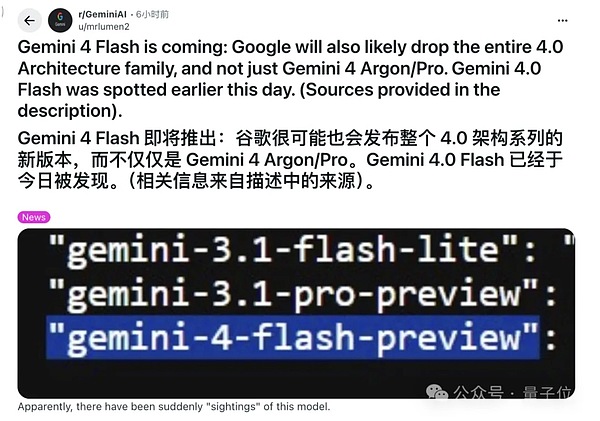
However, judging from Google's update schedule over the past few months, Flash's presence is indeed becoming stronger and stronger. Google just released Gemini 3.8 Flash last month.
According to the official statement, this model maintains low latency and low cost positioning while significantly enhancing long-cycle software engineering, multi-step inference, and agent workflow capabilities.
The flagship model is responsible for exploring the performance ceiling, while Flash handles the larger-scale daily usage needs. Each gets what they need—it's a good balance!
And, incidentally, it's also worth mentioning that Google has recently been adjusting the subscription tiers for its Gemini product... (Here we go again!!)
According to The Verge, starting October 9th, access to Flash, Pro, and other models for free users will be further restricted.
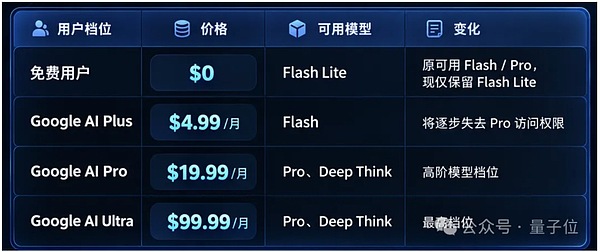
Previously, free users could switch between Flash Lite, Flash, and Pro; now, the free tier only retains Flash Lite.
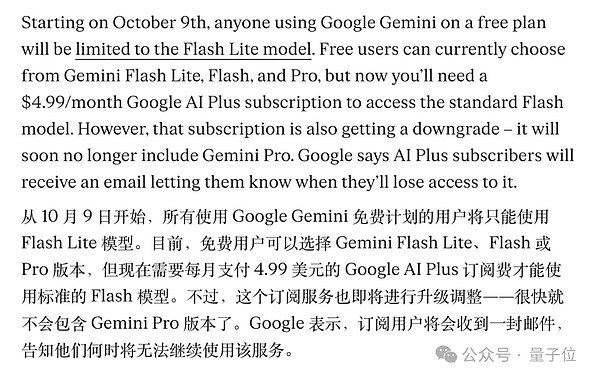
To continue using standard Flash, users need to subscribe to Google AI Plus, which costs at least $4.99 per month.
Even paid AI Plus users are not immune. Google says that users in this tier will gradually lose access to the Pro model, and affected users will receive email notifications.
As for the Pro and Deep Think versions, they require a Google AI Pro subscription of $19.99 per month or an Ultra subscription of $99.99 per month.
Ouch, I'm back again to help you guys understand this with just one picture—
On one hand, Gemini 4 continues to break performance records; on the other hand, the number of models available to free users is decreasing.
That's true; the new model hasn't even been fully launched yet, but the menu has already been repriced.
Those who are interested can just wait and see!
Source:Global Cybersecurity Alliance (GCSA)
Website:www.gcsa.org
Get updates in your inbox
We respect your privacy. See our Privacy Policy